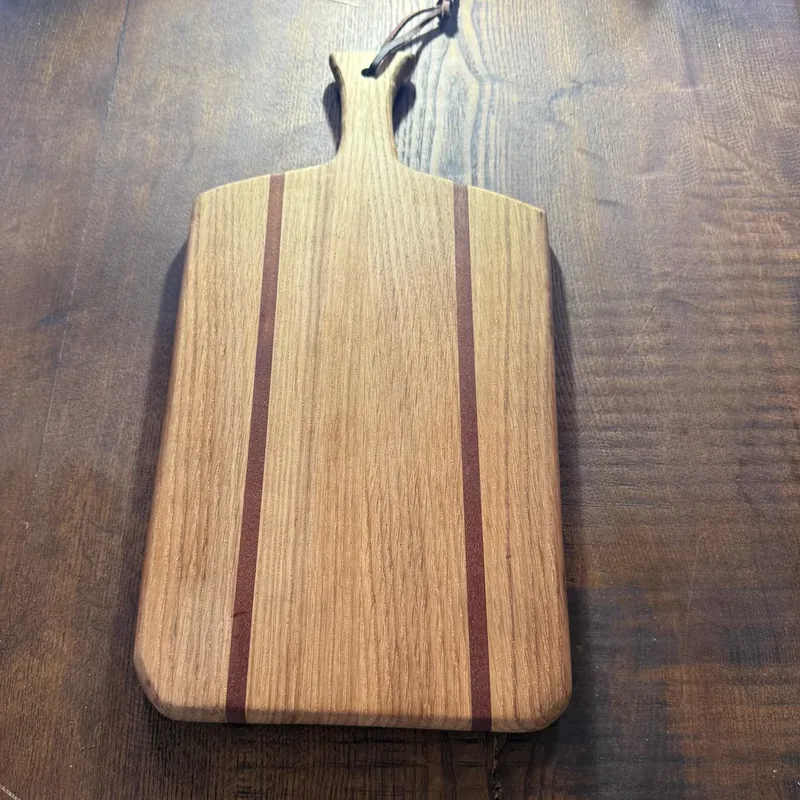
The golden rules
If you remember nothing else, remember these four. Every problem I see with a wooden board — a warp, a split, a dull grey surface — comes from breaking one of them.
- Hand‑wash only. Never the dishwasher, not even once.
- Never soak it. A board should be wet for seconds, not minutes.
- Dry it standing on its edge, so both faces get the same air.
- Re‑oil when it looks dry or pale. The wood will tell you.
Washing after every use
Warm water, a little mild washing‑up liquid, and a cloth or soft brush. Wipe both sides — even if you only used one — then rinse and move straight on to drying. The whole thing should take well under a minute.
Washing both faces matters more than it sounds. If one side gets wet and the other stays dry, the wet side swells slightly, and the board bows. Treat both faces the same and it stays flat.
Why no dishwasher?
Heat, steam and standing water — the three things timber hates most.
A dishwasher cycle holds the board at high temperature in near‑constant moisture for an hour or more. The wood swells unevenly, the grain lifts, and when it finally dries out it cracks. One cycle can ruin a board that would otherwise have lasted decades.
Drying it properly
Give it a quick towel‑dry, then stand it upright — on its edge against the wall, or in a plate rack. Air needs to reach both faces evenly. A board left lying flat on the worktop traps water underneath, dries unevenly, and that’s exactly how warping starts.
Removing stains and smells
Garlic, onion and fish all leave their mark. Every couple of months — or whenever the board needs it — cut a lemon in half, sprinkle the board with coarse salt, and scrub the surface with the cut face of the lemon. The salt lifts residue out of the grain; the lemon’s acidity neutralises the smell.
Rinse, dry on its edge as usual, and re‑oil afterwards, because the lemon and salt will have pulled some oil out of the surface. For bicarbonate, vinegar, stubborn stains and black spots, there’s a full cleaning guide here.
Keeping it nourished
Oil is what keeps water on the surface instead of soaking in. When the board starts to look pale, dull or slightly rough, it’s asking for a coat. With regular use that’s every few weeks; for an occasional serving board, once a month is plenty. There’s a full guide to oiling here, including which oils to use and which to avoid.
The routine, in four steps
- Wash both sides with warm water and a little mild soap.
- Rinse thoroughly — but never leave it soaking.
- Stand it on its edge to dry evenly.
- Oil it when the wood looks dry.
Frequently asked questions
Can I put a wooden chopping board in the dishwasher?
No. The heat and standing water make the timber swell, warp and eventually crack. Always hand‑wash, and dry the board standing on its edge.
How often should I oil a wooden board?
Every few weeks with regular use, or once a month otherwise — whenever the wood looks dry or pale, or water stops beading on the surface.
Is a wooden board safe for raw meat?
Yes, as long as it’s kept clean and dry. Wash thoroughly straight after cutting raw meat, and give it the salt‑and‑lemon scrub regularly. Many people keep a separate board for raw meat, which is a sensible habit.